#5 Clarity Before Certainty: How to Lead and Decide When You Don't Have All the Answers met Krasi Bozhinkova
Krasi Bozhinkova
Gast
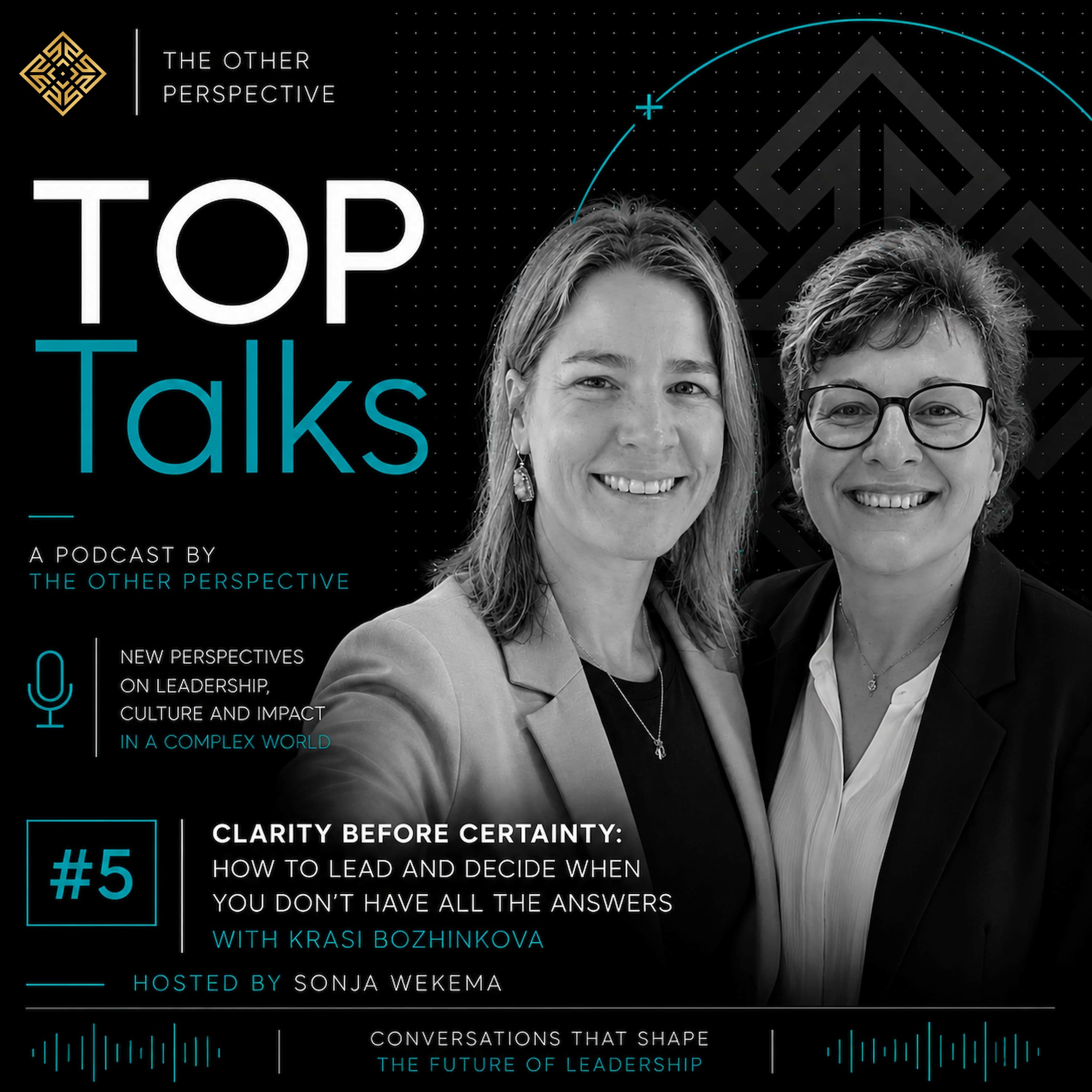
Over deze aflevering
Helderheid voor zekerheid. Krasi Bozhinkova deelt met Sonja Wekema hoe je leidt en beslist wanneer je niet alle antwoorden hebt — en waarom clarity before certainty essentieel is in een wereld die vraagt om wendbaarheid, niet om perfectie.
Luister verder
Aanbevolen afleveringen over verwante thema's
 00217:03·NL
#2 Menselijk blijven in een wereld vol AI met Marly Teunissen
AI is allang geen toekomstmuziek meer — het verandert nu al hoe we werken, leren en leidinggeven. Sonja Wekema gaat in gesprek met Marly Teunissen over de impact van AI op organisaties, medewerkers en leiderschap. Niet vanuit hype of angst, maar vanuit nieuwsgierigheid, kritisch denken en menselijke ontwikkeling. Over relevant blijven, samenwerken met AI zonder blind te volgen, en de menselijke kant van technologische verandering.
AILeadershipNLLuister 00955:48·EN
#9 Leading Between Worlds met Yoshi Hashimoto
Leiden tussen werelden. Yoshi Hashimoto laat Sonja Wekema zien hoe een cross-culturele blik westerse leiderschapsaannames kantelt — over stilte, hiërarchie en wat we missen als we alles in modellen willen vatten.
InterculturalFuture SkillsENLuister
Transcript
Krasi Bozhinkova on deciding without all the answers. Topics: clarity before certainty, dealing with uncertainty, judgement and innovation.
Full transcript available in Dutch and English.
ENRead the full conversation
Clarity Before Certainty (EN)
Krasi Bozhinkova on deciding without all the answers. Topics: clarity before certainty, dealing with uncertainty, judgement and innovation.
Sonja Wekema Welcome to TOP Talks, the podcast by The Other Perspective. Today we are here with Krasimira Bozhinkova. But let me just call you Krasi. It's much easier. So Krasi and I, we already know each other for quite some time, since 2019. Our paths crossed here in The Hague, and we have something in common, and that is that we both worked in a big corporate organisation and at some point decided to become self-employed and enjoy the world in a different way. Krasi is from Bulgaria, and there she did a master in engineering in Sofia and then later on she moved here. Around 2001.
Krasi Bozhinkova Second January, I remember.
Sonja Wekema Second January. Wow, that's a moment to move.
Krasi Bozhinkova Yes.
Sonja Wekema Then you moved to the Netherlands?
Krasi Bozhinkova The airport was empty, you know. People were still celebrating and I was there with all my suitcases. Large suitcases. Yes.
Sonja Wekema Oh, wow.
Krasi Bozhinkova Yeah.
Sonja Wekema And you moved here for your job?
Krasi Bozhinkova I did come here for the job, long before Bulgaria was actually part of the European Union, so I had to deal with a lot of paperwork and issues. But I was young and I was full of energy and I thought it's a great adventure.
Sonja Wekema So you did the executive MBA here at Erasmus University in Rotterdam, and later on you also went to the Digital Marketing Institute in Ireland to get your degree there. So you're also one of these people, someone who continues learning in their life.
Krasi Bozhinkova Yeah, I think I was very curious and I wasn't settled with one career path being an engineer. I'm actually a customer person and I want to solve complex problems related to the product, to the experience, to the design, which led me on a different career path. And I actually never regretted moving away from engineering into the business world, because it allowed me to be myself and to unleash my creativity in that respect.
Sonja Wekema And that's also how I know you, that you are a really creative person. Krasi helped me and my business partner Daphne Laan as well, when we started The Board Whisperers with: what are your shared values? And it was in the period of COVID, I remember that we went really deep also in discovering our values and what should be the values of the company. And one of the things I remember is about not being in a box and learning a lot. So at some point we were online in one of those tools and Krasi, or maybe it was your business partner, created circles. I don't know how to explain this, but these circles were stuck. And every time we saw this, Daphne and I were like: okay, let's get out of those boxes because that's not what we would like to do. So getting out of something and not being stuck, I think that is something that links all of us.
Krasi Bozhinkova Indeed. And this was an interesting work and exploration because the brand was emerging back then. You weren't set out on one direction or another. And I felt it's actually a big opportunity and responsibility to guide you through from what I knew about how to indeed determine your direction, linked to your values, and think about what difference you want to make in the world of your clients. So I totally enjoyed that experience.
Sonja Wekema Yeah. One of the things you already mentioned is: you moved from Bulgaria to the Netherlands. You moved from being an engineer to much more customer focused.
Krasi Bozhinkova And one more thing. I moved from the corporate world to the startup world. So I've been on this transition path pretty much half of my life without realising that I cannot settle in one box as you call it, and I'd like to expand my service. And I'm a person who is really curious and dynamic. And I think this matches my personality also, especially moving from the corporate to the startup world which operates on different timelines and different speed, and now it's even accelerating more rapidly than ever, thanks to AI. It's a good and a bad thing, but still the journey continues and I'm really excited to see how these new dynamics and these new pressure points actually impact innovation specifically. Because we see now a lot of movements and I do work in the product and design space. So when I interact with clients, I see all of those limitations that before when stuck in execution are now being lifted. So people have the total freedom to actually be much more proactive and see the ideas coming to life. But I also realised that this new environment introduces new pressure points, and one that I'm specifically lately passionate about is this notion of judgement, or common sense, or whatever else you want to call it. But this ability to actually get clarity before you are a hundred percent certain. And now we live in a unique moment when this is more important than ever, in my opinion.
Sonja Wekema What does that mean, to create clarity when you're not 100% certain?
Krasi Bozhinkova This means a couple of things, but more importantly in my opinion, it comes down to thinking a lot about the real decision that you're making, not the one that appears on the surface, but the big decision that obviously has consequences. So giving clarity before certainty means revealing these important trade-offs that carry costs and consequences. And I'm not talking just here about product decisions, I'm also talking about leadership decisions, organisational decisions. It's a slippery slope when you get into this domain, but everything starts with talking openly about these trade-offs and mapping the consequences, but also not forgetting ultimately what this means to your customers and what kind of outcomes you actually want them to be able to experience. And last but not least, when I think about clarity before certainty, I also feel like it has to be grounded in the business priority so that everyone in the organisation buys into the direction, before you have all the data that you need to support your choice. And that's a tricky one. I see a lot of oscillation right now, people really moving left and right, top and bottom, testing all possible ideas. One client was advocating 400 prototypes, if you believe it or not, and I was deeply concerned, actually scared for them, worried that they're not going to learn as much as they think, because just because you can ship things doesn't mean that what you are building matters, and you still have to answer these difficult questions.
Sonja Wekema I think you say quite a lot of different things and also from different angles. So you look at the product side, you look at the leadership side, you look at the decision-making power.
Krasi Bozhinkova And the personal side, because ultimately, if you want to grow and if you want to secure more important responsibility in your career, you have to make tough decisions. And these tough decisions, in my opinion, all collide or converge into this idea of clarity in: what are we really doing? Why are we doing it? What risks are we willing to take? And how are we fully committed to take the rest of the organisation on this journey?
Sonja Wekema Yeah. As you know, I've also been part of quite a lot of these conversations in organisations and I use the words of Brene Brown quite a bit. Clear is kind, unclear is unkind. And that really rings a bell for quite a lot of people. I'll also put the link in the show notes. But what people also say is: it's all nice on paper and I want to create clarity, I want to make sure that people understand what I'm deciding, but I don't know everything that is happening around me. And am I the right person to make that decision? Because there's always another person who has something to say. So what do you see in your work?
Krasi Bozhinkova Totally. And I think that this fear, the burden that comes when you are high in the leadership organisation with the consequences of your decisions, is not to be underestimated. But I think now, for those who want to experience what it's like to lead organisations through a very unique and interesting time, it's the perfect opportunity to approach judgement and decision-making not from the angle of providing a hundred percent guarantees, because no one can do that, and it's not about being a hundred percent sure either. It's about assessing: is this the right decision for this point in time for the organisation, yes or no? And then explaining what does it take to get to the next step.
Sonja Wekema Yeah. So maybe also a nice bridge to making our scope a bit bigger, because your background in the corporate world was in the satellite business, and of course I used to work in the energy business, where exploration also costs a lot of money. So you need to understand what are the elements to base these decisions on. And if you do it wrongly, then it will cost you quite a bit.
Krasi Bozhinkova A lot, not just a little bit. Those mistakes, especially in industries with heavy investments, like the satellite industry you mentioned, it's a multimillion dollar mistake. A mistake that lands with gravity is not a simple software bug, and it's not just a little churn that you experience on your metrics. It's a whole other ball game. And not everyone is prepared to live with such pressure. But I realised, when I was actually questioning myself, why am I so passionate about this judgement and why am I even the right person to have this conversation? I realised it's just because I spent almost 19 years of my career in this space. I actually had to learn how to deal with such pressure of not having all the data. Because when we would make decisions, we had to think at least two or three years ahead. And for obvious reasons, we didn't use crystal balls. I wish they were there, but they don't exist. So we had to use other ways of at least validating certain aspects of the demand and thinking about how we're going to deal with this risk, so that we don't stop the whole organisation and sit and wait. We did not have this luxury. But I learned, I made mistakes, and it made me aware of certain aspects, which now I'm passionate about sharing with others, helping them on their journey. Being in hardware or software, I think there are a lot of similarities and parallels you can draw, because the mechanism of how you approach the problem space is, in that context, universal. Judgement applies to so many aspects in our lives, and if you learn how to do it well, I personally think it can help you on a personal level as well.
Sonja Wekema I'm a bit disappointed that you didn't find that crystal ball, because we keep getting those questions.
Krasi Bozhinkova I'm still working on it. And now I have AI, but I still lack.
Sonja Wekema So AI is your crystal ball, is that what you want to say?
Krasi Bozhinkova Sometimes I wish it is. I'm tasking it to be my crystal ball, but even it refuses. But jokes aside, I think it's important to talk about the challenges when it comes to that, because only through exploring what is at the edge of possibilities, I think we can learn and we can actually approach this new world in a more responsive way without being overwhelmed, or paralysed, or even worse, stuck. Because I think a lot of teams and people on a personal level feel stuck when everything changes all the time exponentially. It's a lot to take.
Sonja Wekema Yeah. And what you say also, I get a lot of pictures in my mind when I hear you speak. People who are stuck: how do you help them get unstuck, but also how do you help them take their own responsibility again? And of course there are different areas and different elements that are at play at that moment. So there's the context. Where are people, do they get support? Do the people who want to give them support also get support? And that's more the ecosystem way of looking at this. And what you say, making these kinds of decisions when sometimes billions of dollars or euros are at stake: how can you create that peace of mind? And what kind of person do you need to be, or what kind of team do you need to build around you to be able to still make those decisions? Can you say something about that?
Krasi Bozhinkova Sure. I think that this highlights even more importantly than before this aspect of diversity. If for example you're a software organisation, I would say: hire people from the hardware world. They may teach you something that you underestimate in terms of how to absorb risk and how to deal with it differently, and the other way around. So I think we actually undermined the importance of diversity in the past, just because things were slower and somehow we managed to still get our grounding with what was going on. But these days I think it's paramount that the team looks for talent and skills beyond the obvious. Because frankly, if you just rely on the expertise in your domain, you can use AI to a large extent. But if you want to increase the points of view, the experiences, and bring these unique solutions or capabilities from adjacent industries, you have to open your talent search to people from very different backgrounds than yours, because they're the ones who can bring the perspective that you need to really move away from the common, because everyone now with AI thinks at an average level. So it has raised the importance of being different. But to be different, you also have to think different. And to your point, on a personal level, how to cope with that: my go-to strategy is actually not to limit my curiosity, but to go even more into the arts world or the pure science world of mathematics, or other domains outside of what I usually work on, just because this helps me think more clearly. And yeah, challenge myself to do new things all the time. My next one would be to figure out how I'm going to get an agent to help me sell coffee.
Sonja Wekema What you say I think is an important one, and especially in the time that we are at this moment, diversity is of course a word that some people are even not talking about anymore.
Krasi Bozhinkova Sorry to interrupt you. I mean specifically diversity in background and diversity in thinking, not necessarily diversity just in culture. This helps, but more importantly, you need to bring people from other industries, other sectors, if you really want to move the needle and outperform.
Sonja Wekema Yeah. And it reminds me: one of the things that I'm involved in together with my colleagues from The Other Perspective is we help leaders work on their own case studies. And we do that with groups of sometimes 30 people from different industries, from different functional areas, different expertise areas. We do that with people with different kinds of backgrounds, as you say, diversity of thought. And that is not always what people think of when they say the word diversity, but this is what it's all about. And especially what you also mentioned, AI. If you want to come up with something innovative that's probably not really possible yet, even though you would like AI to be the crystal ball you just mentioned. So also for people who are listening, what would be your advice? Because you of course have reinvented yourself several times and you are not afraid, or maybe not afraid anymore, of jumping.
Krasi Bozhinkova Actually I'm always afraid, but I just don't know what is on the other side. Therefore, I feel courageous. But if I would have known what it takes to run a startup, or two potentially, I would have made different choices. But
Sonja Wekema But you still did.
Krasi Bozhinkova Yes, I still did. And I would say to people: I think you need to trust yourself and trust a little bit more your instinct than in the past. And if something feels good for you, try it. It doesn't need to be permanent. So those decisions are usually reversible. So even if you decide to explore a different career or try a different job, a different function, and you don't like it, at least you've known. But do not limit yourself and take away this opportunity to experience something a little bit outside of your comfort zone, because that's the only way to know, and the only way to, in my opinion, remain curious.
Sonja Wekema Yeah. So push yourself, and you don't have any guarantees about where you are today. And what you say as well: every time you do something new, you don't know what's going to happen.
Krasi Bozhinkova Yeah. And there is another thing that I actually learned from another side of my experience as a person, which comes from running. I started running, I don't know, 10 or 15 years ago, and I learned that whatever you think you can do, you can actually double it. And the first thing that gives away is not your body, it's your mind. So if you can stretch your mind a little bit, I think you can go very, very far.
Sonja Wekema Is there anything in particular that you would want to discuss with the listener?
Krasi Bozhinkova I think it's important, if you have an influence on your company, product or strategy, or any important aspect that impacts the business success, to allow yourself to actually reevaluate where your differentiation still is. I know that this may sound a bit abstract, but what I mean is: do not limit yourself to think that whatever worked in the past is going to be the same thing that is going to be relevant tomorrow, because things are moving really fast. And if I had a crystal ball, I would say we underestimate the impact of change. We think that it is going to be gradual, but actually it's a little bit more than that and it's quite exponential. So now is the time to go back to the basics. And for those who have this opportunity, bring forward the uncomfortable truths into their organisations and think about what does this mean for the business, the product, but more importantly the people. Because without people, what do you have? So I think those in a leadership position have this responsibility for the rest of them to speak out and not be afraid, even if what they have to say is uncomfortable. And most likely it's going to be uncomfortable. But if we don't face these difficult decisions now, it's going to hurt even more down the line.
Sonja Wekema Yeah. So speak up if you see something that is not going the right way. And I think also implicitly what you say is: leaders are not per se people in a management position. Everyone can be a leader, but it all starts with finding out who you are, what you find important, what you really want to push forward also for the future, and what role you can play. But I also know that for some people that sounds easy, but still there are always those little voices in their minds who might say: who do you think you are? The famous imposter syndrome. How do you silence those voices? Do you have any idea?
Krasi Bozhinkova I think you need to remember that, especially right now with AI, if we talk about it, everyone is discovering it. So as much as we want to say there are experts, I think we are all in the same boat. Some just spend more time with it and have more experience. But generally speaking, it's like the beginning of something. So there is no imposter syndrome in that respect. Some are more confident, some are not. But all voices should be heard. And those who have ideas: now is the time to actually express them, more so than in the past, because it's the beginning of a new era in a sense. And how do you silence this imposter syndrome? Well, I always ask myself: what can go wrong if I speak up? At most I can upset people. I can make a fool of myself. But what if what I have to say could make a real difference? And I think I'll feel much more guilt if I don't make impact as opposed to if I fail. So I am okay to fail, but I'm not okay to live with the consequences and that responsibility. So that's how I think about it.
Sonja Wekema I think we had it in the previous podcast as well. We spoke about passion. If you really want to go all the way, sometimes you need to do things that don't feel that nice, that take you out of your comfort zone, but you know why you do this and you know why you want to move. What matters to you. And if you do this in a congruent way, you also have the enthusiasm that will bring other people along.
Krasi Bozhinkova Yes. And I think you actually become who you are meant to be to start with, but only by exploring these edges, at what happens at the edges. Because I believe that that's where actually the character is built. If everything was smooth and easy and polished, I would argue that that's nice, but ultimately you miss this authenticity of who you are as a person. And you can only find it unfortunately in these messy places where there are no clear answers, where things are ambiguous, when there is no black or white. But that's the beauty of it. And that's how we, I think, can maintain our humanity, because that's definitely not a space for AI. There are things with a much more clear set of answers. AI doesn't do well with nuances, and multiple right answers, and all of these contradictions, which as humans we are quite capable of. So I think we need to tap more into this aspect.
Sonja Wekema Yeah. So also working with AI, but also with the other human beings here on earth.
Krasi Bozhinkova Absolutely.
Sonja Wekema So I hear a plea also for connecting with people who are like you: human beings. Because only then can we do impactful things that are going to help us also for a sustainable future.
Krasi Bozhinkova Yeah. Technology is nice, but ultimately it's just a tool. It's another tool. It can change fundamentally many things, just like fire changed real world society. But I don't think it's wise to dedicate all your passion and effort to figuring out AI, because the human aspects remain difficult. And in the contradiction and in these messy spaces is where I think we find beauty in the world and in life.
Sonja Wekema For the people who want to learn and hear more of you, Krasi, you are a speaker at various conferences and you work on live sessions on LinkedIn. Can you say a bit more about that?
Krasi Bozhinkova Yes, thanks Sonja. I am on multiple channels. I am quite passionate about talking about what AI is changing. And I started a couple of months ago this LinkedIn Live called AI Pressure Cooker, where we talk about the whistle, the heat, the difficult decisions. So I encourage the listeners: if you have a great story, just find me on LinkedIn and I'd love you to be a guest and hear your perspective. I also do something different in that I'm exploring a culture of signals and looking at outliers to see what this can tell us, how we are moving and how we can build more impactful brands and products. This piece of work resides on Substack, it's called The Signal Brief. I publish those monthly, so they're quite entertaining. I must say I am also amazed myself at what I find. So give it a try. And if you happen to be at some of the product and design conferences in Amsterdam, like IEX or UX Rotterdam, or if you're part of the product community and you see me on stage, just say hi. I am always curious to make new friends and new connections. And you can find more information about my work at woutcome.com.
Sonja Wekema Thank you very much, Krasi. We could easily spend two hours on a lot of different topics, but we will probably have you again as our guest on TOP Talks. Thank you very much. I will put all the links in the show notes so that it's easy for you to find Krasi.
Krasi Bozhinkova Thanks Sonja. It was a pleasure being here and I really appreciate the opportunity to share my insights and make sense of this unique period in time right now. Thank you. Bye-bye.
Sonja Wekema This was TOP Talks. Leadership grows in conversation, not in isolation. Subscribe to TOP Talks on Spotify, Apple Podcast, and follow The Other Perspective on LinkedIn for more on leadership in a complex world. Until next time.
---
NLToon transcript
Clarity Before Certainty (NL)
Krasi Bozhinkova over besluiten nemen zonder alle antwoorden. Onderwerpen: helderheid vóór zekerheid, omgaan met onzekerheid, oordeelsvorming en innovatie.
Sonja Wekema Welkom bij TOP Talks, de podcast van The Other Perspective. Vandaag zijn we hier met Krasimira Bozhinkova. Maar laat me je gewoon Krasi noemen. Dat is veel makkelijker. Krasi en ik kennen elkaar al behoorlijk lang, sinds 2019. Onze paden kruisten hier in Den Haag, en we hebben iets gemeen: we hebben allebei gewerkt in een grote corporate organisatie en hebben op een gegeven moment besloten voor onszelf te beginnen en de wereld op een andere manier te beleven. Krasi komt uit Bulgarije, waar ze een master ingenieurswetenschappen deed in Sofia, en later verhuisde ze hierheen. Rond 2001.
Krasi Bozhinkova Twee januari, ik herinner het me nog precies.
Sonja Wekema Twee januari. Wow, dat is een moment om te verhuizen.
Krasi Bozhinkova Ja.
Sonja Wekema Toen verhuisde je naar Nederland?
Krasi Bozhinkova Het vliegveld was leeg. Mensen waren nog aan het feesten en ik stond daar met al mijn koffers. Grote koffers. Ja.
Sonja Wekema Oh, wow.
Krasi Bozhinkova Ja.
Sonja Wekema En je verhuisde hier voor je werk?
Krasi Bozhinkova Ja, ik ben hierheen gekomen voor mijn baan, lang voordat Bulgarije onderdeel was van de Europese Unie. Dus ik moest veel papierwerk en allerlei zaken regelen. Maar ik was jong, vol energie en dacht: dit is een groot avontuur.
Sonja Wekema Je deed de executive MBA aan de Erasmus Universiteit in Rotterdam, en later ging je ook naar het Digital Marketing Institute in Ierland voor je diploma. Je bent ook iemand die blijft leren in het leven.
Krasi Bozhinkova Ja, ik denk dat ik heel nieuwsgierig was en me niet kon vinden in dat ene carrièrepad van ingenieur. Ik ben eigenlijk een mensgerichte persoon die complexe problemen wil oplossen rondom het product, de ervaring, het ontwerp. Dat heeft me naar een ander pad geleid. En ik heb nooit spijt gehad van de stap weg van de techniek naar de zakelijke wereld, omdat het me in staat stelde mezelf te zijn en mijn creativiteit de vrije loop te laten.
Sonja Wekema En dat is ook hoe ik jou ken: als iemand die echt creatief is. Krasi heeft mij en mijn zakenpartner Daphne Laan ook geholpen toen we The Board Whisperers startten: wat zijn jullie gedeelde waarden? Het was in de COVID-periode, ik herinner me dat we echt diep gingen in het ontdekken van onze waarden en wat de waarden van het bedrijf moesten zijn. En één van de dingen die ik me herinner is: niet in een hokje zitten en veel leren. Op een gegeven moment waren we online in één van die tools, en Krasi, of misschien jouw zakenpartner, maakte cirkels. Ik weet niet goed hoe ik dit moet uitleggen, maar die cirkels waren vast. En elke keer dat we dat zagen, dachten Daphne en ik: oké, laten we uit die hokjes stappen, want dat is niet wat we willen. Dus ergens uitbreken en niet vastzitten, ik denk dat dat iets is wat ons verbindt.
Krasi Bozhinkova Inderdaad. En het was interessant werk en verkenning, want het merk was aan het ontstaan. Je had nog geen duidelijke richting gekozen. En ik voelde dat het een grote kans en verantwoordelijkheid was om jullie te begeleiden vanuit wat ik wist over het bepalen van je richting, verbonden aan je waarden, en nadenken over welk verschil je wilt maken in de wereld van je klanten. Ik heb dat echt genoten.
Sonja Wekema Ja. Zoals je al noemde: je verhuisde van Bulgarije naar Nederland. Je ging van ingenieur naar een veel meer klantgerichte rol.
Krasi Bozhinkova En nog één ding. Ik ben overgestapt van de corporate wereld naar de startup wereld. Ik ben mijn halve leven al bezig met transities, zonder dat ik me realiseerde dat ik me niet kan settelen in één hokje en dat ik mijn dienstverlening wil uitbreiden. Ik ben iemand die heel nieuwsgierig en dynamisch is. En dat past ook bij mijn persoonlijkheid, zeker de stap van corporate naar startup, die op andere tijdlijnen en snelheden werkt. En nu versnelt alles nog sneller dan ooit dankzij AI. Dat is goed én slecht, maar de reis gaat door en ik ben heel benieuwd hoe deze nieuwe dynamiek en drukpunten de innovatie beïnvloeden. Ik werk in de product en designwereld en zie bij klanten dat beperkingen die er eerder waren nu worden weggenomen. Mensen hebben nu de vrijheid om veel proactiever te zijn en ideeën tot leven te brengen. Maar ik realiseerde me ook dat deze nieuwe omgeving nieuwe drukpunten introduceert. Eén waar ik de laatste tijd erg gepassioneerd over ben is dit idee van oordeelsvermogen, of gezond verstand, of hoe je het ook wilt noemen. Die vaardigheid om helderheid te creëren voordat je honderd procent zeker bent. En we leven nu op een uniek moment waarop dit belangrijker is dan ooit, wat mij betreft.
Sonja Wekema Wat betekent dat, helderheid creëren als je niet 100% zeker bent?
Krasi Bozhinkova Dat betekent een aantal dingen, maar het belangrijkste is in mijn ogen: goed nadenken over de echte beslissing die je neemt, niet de beslissing die aan de oppervlakte verschijnt, maar de grote beslissing die consequenties heeft. Helderheid geven voor zekerheid betekent: deze belangrijke afwegingen blootleggen die kosten en consequenties met zich meebrengen. En ik heb het hier niet alleen over productbeslissingen, maar ook over leiderschaps- en organisatiebeslissingen. Het is een glibberig pad als je dit domein betreedt, maar alles begint met open praten over die afwegingen en de consequenties in kaart brengen, maar ook niet vergeten wat dit uiteindelijk betekent voor je klanten en welke resultaten je voor hen wil bereiken. En last but not least: als ik denk aan helderheid voor zekerheid, moet het ook verankerd zijn in de bedrijfsprioriteit, zodat iedereen in de organisatie achter de richting staat voordat je alle data hebt om je keuze te onderbouwen. En dat is een lastige. Ik zie nu veel oscillatie, mensen gaan alle kanten op en testen alle mogelijke ideeën. Eén klant pleitte voor 400 prototypes, geloof het of niet. En ik was diep bezorgd, eigenlijk bang voor ze, want alleen maar iets kunnen uitbrengen betekent niet dat wat je bouwt ertoe doet. Je moet die moeilijke vragen nog steeds beantwoorden.
Sonja Wekema Ik denk dat je veel verschillende dingen zegt en ook vanuit verschillende invalshoeken. Je kijkt naar de productkant, de leiderschapskant, de besluitvormingskant.
Krasi Bozhinkova En de persoonlijke kant, want uiteindelijk, als je wil groeien en meer verantwoordelijkheid wil in je carrière, moet je moeilijke beslissingen nemen. En die moeilijke beslissingen komen in mijn ogen allemaal samen in dit idee van helderheid over: wat doen we eigenlijk? Waarom doen we het? Welke risico's zijn we bereid te nemen? En hoe zijn we volledig toegewijd om de rest van de organisatie mee op deze reis te nemen?
Sonja Wekema Ja. Zoals je weet ben ik ook betrokken geweest bij veel van dit soort gesprekken in organisaties en ik gebruik de woorden van Brené Brown regelmatig. Helder zijn is vriendelijk, onduidelijk zijn is onvriendelijk. En dat raakt een snaar bij heel veel mensen. Ik zet de link ook in de shownotes. Maar wat mensen ook zeggen is: het klinkt allemaal mooi op papier. Ik wil helderheid creëren, ik wil dat mensen begrijpen wat ik besluit, maar ik weet niet alles wat er om me heen gebeurt. En ben ik de juiste persoon om die beslissing te nemen? Want er is altijd iemand anders die er iets over te zeggen heeft. Wat zie jij in je werk?
Krasi Bozhinkova Totaal. En ik denk dat die angst, die last die je voelt als je hoog in een leiderschapspositie zit met de consequenties van je beslissingen, niet te onderschatten is. Maar ik denk: voor degenen die willen ervaren hoe het is om organisaties te leiden in een zeer unieke en interessante tijd, is het nu het perfecte moment om besluitvorming niet te benaderen vanuit het bieden van honderd procent garanties, want dat kan niemand. En het gaat er ook niet om honderd procent zeker te zijn. Het gaat erom te beoordelen: is dit de juiste beslissing voor dit moment in de organisatie, ja of nee? En dan uitleggen wat het kost om de volgende stap te zetten.
Sonja Wekema Ja. Misschien ook een mooie brug naar het vergroten van ons perspectief, want jouw achtergrond in de corporate wereld was in de satellietsector, en ik werkte in de energiesector, waar exploratie ook veel geld kost. Dus je moet begrijpen welke elementen meespelen in die beslissingen. En als je het fout doet, kost het je behoorlijk wat.
Krasi Bozhinkova Veel, niet een klein beetje. Die fouten, zeker in sectoren met grote investeringen zoals de satellietsector, zijn een fout van meerdere miljoenen dollars. Een fout die met zwaartekracht landt is geen simpele softwarebug, en het is niet een klein beetje klantverloop op je metrics. Het is een heel ander spel. En niet iedereen is bereid om met zulke druk te leven. Maar ik realiseerde me, toen ik mezelf afvroeg waarom ik zo gepassioneerd ben over dit oordeelsvermogen en waarom ik überhaupt de juiste persoon ben voor dit gesprek, dat het simpelweg is omdat ik bijna 19 jaar in dit vakgebied heb gewerkt. Ik moest leren omgaan met de druk van het niet hebben van alle data. Omdat we bij het nemen van beslissingen minstens twee à drie jaar vooruit moesten denken. En we gebruikten geen kristallen bollen. Ik wou dat ze bestonden, maar dat doen ze niet. Dus we moesten andere manieren vinden om bepaalde aspecten van de vraag te valideren en na te denken over hoe we met dit risico omgaan, zodat we de hele organisatie niet stilzetten. Die luxe hadden we niet. Maar ik heb geleerd, fouten gemaakt, en dat maakte me bewust van bepaalde zaken die ik nu graag met anderen deel. In hardware of software, er zijn veel overeenkomsten die je kunt trekken, want de manier waarop je het probleemdomein benadert is universeel. Oordeelsvermogen is van toepassing op zo veel aspecten van ons leven, en als je leert het goed te doen, kan het je ook op persoonlijk niveau helpen.
Sonja Wekema Ik ben een beetje teleurgesteld dat je die kristallen bol niet hebt gevonden, want we blijven die vragen krijgen.
Krasi Bozhinkova Ik werk er nog aan. En nu heb ik AI, maar ik mis nog steeds iets.
Sonja Wekema Dus AI is jouw kristallen bol, is dat wat je wilt zeggen?
Krasi Bozhinkova Soms wou ik dat het zo was. Ik geef het de opdracht mijn kristallen bol te zijn, maar zelfs dat weigert het. Maar grapjes terzijde, ik denk dat het belangrijk is om te praten over de uitdagingen, want alleen door te verkennen wat aan de rand van het mogelijke ligt, kunnen we leren en deze nieuwe wereld op een responsievere manier benaderen zonder overweldigd, verlamd of vastgelopen te raken. Want ik denk dat veel teams en mensen op persoonlijk niveau vastlopen als alles continu exponentieel verandert. Dat is veel om te verwerken.
Sonja Wekema Ja. En wat je zegt, ik krijg veel beelden in mijn hoofd als ik je hoor praten. Mensen die vastzitten: hoe help je ze loskomen, maar ook hoe help je ze hun eigen verantwoordelijkheid weer te nemen? En er spelen natuurlijk verschillende elementen mee op dat moment. De context. Waar zijn mensen, krijgen ze steun? Krijgen degenen die steun willen geven ook steun? Dat is meer de ecosysteembenadering. En wat je zegt, dit soort beslissingen nemen als er soms miljarden op het spel staan: hoe creëer je die gemoedsrust? En wat voor iemand moet je zijn, of wat voor team moet je om je heen bouwen om die beslissingen toch te kunnen nemen? Kun je daar iets over zeggen?
Krasi Bozhinkova Zeker. Ik denk dat dit het belang van diversiteit nog sterker benadrukt dan voorheen. Als je bijvoorbeeld een softwareorganisatie bent, zou ik zeggen: neem mensen aan uit de hardwarewereld. Zij kunnen je iets leren dat je onderschat over hoe je risico absorbeert en anders mee omgaat, en andersom. Ik denk dat we het belang van diversiteit in het verleden hebben onderschat, gewoon omdat dingen langzamer gingen en we toch onze grondslag konden vinden. Maar tegenwoordig is het cruciaal dat teams talent en vaardigheden zoeken buiten het voor de hand liggende. Want als je alleen vertrouwt op expertise in jouw domein, kun je AI al grotendeels inzetten. Maar als je de invalshoeken, ervaringen wilt vergroten en unieke oplossingen of capaciteiten wilt binnenhalen uit aangrenzende sectoren, moet je je talentzoektocht openstellen voor mensen met een heel andere achtergrond, want zij brengen het perspectief dat je nodig hebt om je echt te onderscheiden. Want iedereen denkt nu met AI op een gemiddeld niveau. Dus het heeft het belang van anders zijn verhoogd. Maar om anders te zijn, moet je ook anders denken. En op persoonlijk niveau: hoe ga je daarmee om? Mijn strategie is juist mijn nieuwsgierigheid niet te beperken, maar dieper de kunstenwereld in te gaan, of de puur wetenschappelijke wereld van wiskunde, of andere domeinen buiten wat ik normaal doe, simpelweg omdat dit me helpt helderder te denken. En mezelf uitdagen om steeds nieuwe dingen te doen. Mijn volgende uitdaging: bedenken hoe ik een AI-agent kan inzetten om koffie te verkopen.
Sonja Wekema Wat je zegt is een belangrijk punt, en zeker in de tijd waarin we ons nu bevinden: diversiteit is natuurlijk een woord dat sommige mensen zelfs niet meer gebruiken.
Krasi Bozhinkova Sorry dat ik je onderbreek. Ik bedoel specifiek diversiteit in achtergrond en in denken, niet alleen culturele diversiteit. Dat helpt, maar belangrijker is: mensen binnenhalen uit andere sectoren als je echt het verschil wil maken en wil uitblinken.
Sonja Wekema Ja. En het doet me denken aan iets: één van de dingen waar ik bij betrokken ben samen met mijn collega's van The Other Perspective is dat we leiders helpen werken aan hun eigen praktijkgevallen. We doen dat met groepen van soms 30 mensen uit verschillende sectoren, verschillende functionele gebieden, verschillende expertisegebieden. We doen dat met mensen met verschillende achtergronden, zoals jij zegt: diversiteit van denken. En dat is niet altijd waar mensen aan denken bij het woord diversiteit, maar daar gaat het om. En zeker ook wat je noemde over AI. Als je iets innovatiefs wilt bedenken dat er misschien nog niet is, ook al zou je wensen dat AI de kristallen bol was. Dus ook voor mensen die luisteren: wat is je advies? Jij hebt jezelf meerdere keren opnieuw uitgevonden en bent niet bang, of misschien niet meer bang, om een sprong te wagen.
Krasi Bozhinkova Ik ben eigenlijk altijd bang, maar ik weet niet wat er aan de andere kant is. Daarom voel ik me moedig. Maar als ik had geweten wat het kost om een startup, of misschien wel twee, te runnen, had ik andere keuzes gemaakt. Maar
Sonja Wekema Maar je deed het toch.
Krasi Bozhinkova Ja, ik deed het toch. En ik zou mensen aanraden: vertrouw op jezelf en vertrouw iets meer op je instinct dan vroeger. En als iets goed voelt, probeer het. Het hoeft niet permanent te zijn. Die beslissingen zijn meestal omkeerbaar. Dus ook al besluit je een andere carrière te verkennen, een andere baan of functie te proberen en je vindt het niks, dan weet je het tenminste. Maar beperk jezelf niet en ontneem jezelf niet de kans om iets buiten je comfortzone te ervaren, want dat is de enige manier om te weten, en de enige manier om nieuwsgierig te blijven.
Sonja Wekema Ja. Dus daag jezelf uit, je hebt geen garanties over waar je vandaag staat. En wat je ook zegt: elke keer dat je iets nieuws doet, weet je niet wat er gaat gebeuren.
Krasi Bozhinkova Ja. En er is nog iets dat ik heb geleerd vanuit een andere kant van mijn ervaring: hardlopen. Ik ben begonnen met hardlopen, ik weet niet, 10 à 15 jaar geleden, en ik leerde dat wat je ook denkt dat je kunt, je het kunt verdubbelen. En het eerste wat het begeeft is niet je lichaam, maar je geest. Dus als je je geest een beetje kunt oprekken, denk ik dat je heel, heel ver kunt komen.
Sonja Wekema Is er iets in het bijzonder dat je de luisteraar zou willen meegeven?
Krasi Bozhinkova Ik denk dat het, als je invloed hebt op het product, de strategie of een belangrijk aspect dat bijdraagt aan het zakelijk succes van je bedrijf, belangrijk is om jezelf toe te staan echt opnieuw te evalueren waar je differentiatie nog steeds ligt. Ik weet dat dit wat abstract klinkt, maar wat ik bedoel is: beperk jezelf niet door te denken dat wat vroeger werkte morgen ook nog relevant zal zijn, want de dingen bewegen heel snel. En als ik een kristallen bol had, zou ik zeggen: we onderschatten de impact van verandering. We denken dat het geleidelijk gaat, maar eigenlijk gaat het meer dan dat en is het exponentieel. Dus nu is het moment om terug te gaan naar de basis. En voor degenen die de kans hebben: breng de ongemakkelijke waarheden naar voren in je organisatie en denk na over wat dit betekent voor het bedrijf, het product, maar ook en vooral de mensen. Want zonder mensen, wat heb je dan? Ik denk dat degenen in een leiderschapspositie de verantwoordelijkheid hebben om voor de rest te spreken en niet bang te zijn, ook al is wat ze te zeggen hebben ongemakkelijk. En hoogstwaarschijnlijk zal het ongemakkelijk zijn. Maar als we deze moeilijke beslissingen nu niet nemen, doet het later nog meer pijn.
Sonja Wekema Ja. Dus spreek je uit als je ziet dat iets niet de goede kant op gaat. En ik denk ook impliciet wat je zegt: leiders zijn niet per se mensen in een managementpositie. Iedereen kan een leider zijn, maar het begint allemaal met uitvinden wie je bent, wat je belangrijk vindt, wat je echt vooruit wil duwen voor de toekomst en welke rol je kunt spelen. Maar ik weet ook dat dit voor sommige mensen makkelijk klinkt, maar dat er altijd die kleine stemmetjes zijn in hun hoofd die zeggen: wie denk je wel dat je bent? Het beruchte impostergevoel. Hoe breng je die stemmen tot zwijgen? Heb je een idee?
Krasi Bozhinkova Ik denk dat je moet onthouden dat, zeker nu met AI, als we het erover hebben, iedereen het aan het ontdekken is. Hoezeer we ook willen zeggen dat er experts zijn, ik denk dat we allemaal in hetzelfde schuitje zitten. Sommigen besteden er meer tijd aan en hebben meer ervaring. Maar over het algemeen is het het begin van iets. Dus er is in dat opzicht geen impostergevoel. Sommigen zijn zekerder, anderen minder. Maar alle stemmen moeten worden gehoord. En degenen met ideeën: nu is het moment om ze uit te spreken, meer dan vroeger, want het is het begin van een nieuw tijdperk. En hoe breng je dat impostergevoel tot zwijgen? Ik vraag mezelf altijd: wat kan er misgaan als ik iets zeg? In het ergste geval maak ik mensen van streek. Ik maak mezelf belachelijk. Maar wat als wat ik te zeggen heb echt verschil kan maken? En ik denk dat ik me veel meer schuldig voel als ik geen impact maak dan wanneer ik faal. Dus ik ben oké met falen, maar niet met de consequenties van niet proberen. Zo denk ik erover.
Sonja Wekema Ik denk dat we dit ook in de vorige podcast hadden. We spraken over passie. Als je echt helemaal wilt gaan, moet je soms dingen doen die niet fijn voelen, die je uit je comfortzone halen, maar je weet waarom je dit doet en waarom je wilt bewegen. Wat er voor jou toe doet. En als je dit op een congruente manier doet, heb je ook het enthousiasme dat andere mensen meeneemt.
Krasi Bozhinkova Ja. En ik denk dat je dan wordt wie je bedoeld bent te zijn, maar alleen door deze grenzen te verkennen, aan de randen van het mogelijke. Want ik geloof dat dat de plek is waar je karakter wordt gevormd. Als alles soepel en makkelijk en gepolijst was, zou dat mooi zijn, maar je mist die authenticiteit van wie je bent als persoon. En die vind je helaas alleen op die rommelplekken waar er geen duidelijke antwoorden zijn, waar dingen ambigu zijn, waar het niet zwart-wit is. Maar dat is de schoonheid ervan. En zo kunnen we, denk ik, onze menselijkheid bewaren, want dat is zeker geen plek voor AI. Er zijn dingen met een veel duidelijkere set antwoorden. AI doet het niet goed met nuances, meerdere juiste antwoorden en al die tegenstrijdigheden, terwijl wij als mensen daartoe heel goed in staat zijn. Dus ik denk dat we meer in dit aspect moeten investeren.
Sonja Wekema Ja. Dus ook samenwerken met AI, maar ook met de andere menselijke wezens hier op aarde.
Krasi Bozhinkova Absoluut.
Sonja Wekema Ik hoor dus ook een pleidooi voor verbinden met mensen, want alleen dan kunnen we impactvolle dingen doen die ons ook helpen voor een duurzame toekomst.
Krasi Bozhinkova Ja. Technologie is mooi, maar het is uiteindelijk gewoon een hulpmiddel. Nog een hulpmiddel. Het kan fundamenteel veel dingen veranderen, net zoals vuur de samenleving veranderde. Maar ik denk niet dat het verstandig is om al je passie en energie te steken in het begrijpen van AI, want het menselijke aspect blijft moeilijk. En in die tegenstrijdigheden en in die rommelige plekken vinden we de schoonheid in de wereld en in het leven.
Sonja Wekema Voor mensen die meer van jou willen horen en leren, Krasi: je bent spreker op verschillende conferenties en je organiseert live sessies op LinkedIn. Kun je daar wat meer over vertellen?
Krasi Bozhinkova Ja, dank je Sonja. Ik ben op meerdere kanalen actief. Ik ben erg gepassioneerd over praten over wat AI verandert. En ik ben een paar maanden geleden begonnen met deze LinkedIn Live genaamd AI Pressure Cooker, waar we het hebben over de fluit, de hitte, de moeilijke beslissingen. Ik moedig de luisteraars aan: als je een goed verhaal hebt, vind me gewoon op LinkedIn en ik zou je graag als gast willen hebben en jouw perspectief horen. Ik doe ook iets anders: ik verken een cultuur van signalen en kijk naar uitschieters om te zien wat ons dat vertelt, hoe we bewegen en hoe we impactvollere merken en producten kunnen bouwen. Dit werk staat op Substack, het heet The Signal Brief. Ik publiceer dat maandelijks, het is best vermakelijk. Ik ben zelf ook verbaasd over wat ik vind. Dus geef het een kans. En als je op een van de product- en designconferenties in Amsterdam bent, zoals IEX of UX Rotterdam, of als je deel uitmaakt van de productgemeenschap en je ziet me op het podium: zeg gewoon hallo. Ik ben altijd nieuwsgierig naar nieuwe vrienden en verbindingen. Meer informatie over mijn werk vind je op woutcome.com.
Sonja Wekema Heel erg bedankt, Krasi. We zouden makkelijk twee uur over allerlei onderwerpen kunnen praten, maar we hebben je waarschijnlijk nogmaals als gast bij TOP Talks. Heel erg bedankt. Ik zet alle links in de shownotes zodat het makkelijk te vinden is.
Krasi Bozhinkova Dank je Sonja. Het was een genoegen hier te zijn en ik waardeer de kans enorm om mijn inzichten te delen en zin te geven aan deze unieke periode in de tijd. Dank je. Tot ziens.
Sonja Wekema Dit was TOP Talks. Leiderschap groeit in gesprek, niet in isolatie. Abonneer je op TOP Talks via Spotify, Apple Podcast, en volg The Other Perspective op LinkedIn voor meer over leiderschap in een complexe wereld. Tot de volgende keer.